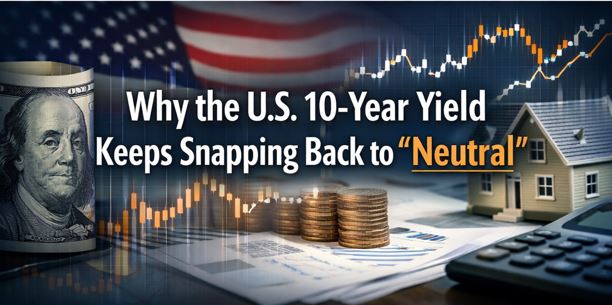
Over the past three years, the U.S. 10-year Treasury yield has repeatedly tested both upside and downside extremes—yet each move has ultimately reverted toward the same gravitational center. Despite inflation shocks, aggressive monetary tightening, fiscal concerns, and episodic growth scares, the 10-year yield has spent the majority of this cycle oscillating between roughly 3.75% and 4.50%, with a rolling two-year average clustered near 4.2%.
That level increasingly represents the market’s definition of “neutral.” It is consistent with a policy environment where the federal funds rate settles just above 3%, inflation stabilizes near 2.5%, and nominal GDP growth expectations hover around 4%. In other words, neither boom nor bust—just equilibrium.
The Case for Neutral: A Range-Bound Reality
Since early 2023, the 10-year yield has behaved less like a trending asset and more like a mean-reverting one. Each surge above 4.50%—typically driven by inflation scares, stronger-than-expected growth, or hawkish Federal Reserve rhetoric—has proven temporary. Likewise, every drop below 3.50%, often sparked by recession fears or financial-conditions tightening, has been short-lived.
The result has been a remarkably persistent trading range. On a 24-month rolling basis, the average yield sits near 4.2%, underscoring that markets repeatedly converge on this level as a fair clearing price for long-term capital.
This behavior reflects a broader transition: markets are moving away from crisis pricing and toward a steady-state framework. The effective fed funds rate currently stands at 3.64%, modestly above most estimates of the long-run neutral rate (generally cited between 3.00% and 3.25% nominal). However, the front end of the curve is already anticipating normalization.
The 2-year Treasury yield near 3.3% implies expectations for gradual easing over the next 12–18 months. Fed funds futures similarly point to policy drifting toward a terminal range just above 3% into 2026. In short, while policy remains restrictive today, markets are already looking through to a post-tightening equilibrium.
Inflation and Real Rates Anchor the Equilibrium
Inflation dynamics reinforce the case for a stable long-term yield anchor. Headline CPI and PCE inflation are currently running close to 2.5% year-over-year, while longer-term expectations remain well contained. Ten-year breakeven inflation rates continue to trade around 2.3%–2.4%, signaling that investors broadly trust the inflation-control framework of the Federal Reserve.
Real rates further support this equilibrium narrative. The real 10-year yield, now near 1.8%–2.0%, is historically consistent with trend real growth in the 1.75%–2.0% range. When combined with inflation expectations in the low-to-mid 2s, nominal growth expectations cluster near 4%—a level that aligns naturally with a 10-year yield in the low-4% range.
In this context, a sustained move materially above 4.5% would likely require either a re-acceleration in inflation or a structural increase in real growth. Conversely, a durable break below 3.5% would imply recessionary conditions or a renewed deflationary threat. Neither scenario is currently being priced.
Treasury Supply: More Narrative Than Disruption
Concerns about Treasury supply have loomed large in market commentary, but so far they have had surprisingly limited impact on long-end yields. The U.S. Treasury has leaned heavily on Treasury bills and shorter-dated coupons to fund elevated deficits, reducing immediate pressure on the 10-year and 30-year sectors.
At the same time, regulatory developments are quietly improving the system’s capacity to absorb supply. Changes to the enhanced Supplementary Leverage Ratio, scheduled to take effect on April 1, 2026, are expected to reduce Tier 1 capital requirements for the largest banks by roughly $13 billion at the holding-company level and approximately $219 billion across major bank subsidiaries. This regulatory adjustment should meaningfully expand balance-sheet capacity to hold Treasuries, helping offset the effects of ongoing quantitative tightening and any acceleration in Fed balance-sheet runoff.
Taken together, supply pressures remain a headline risk—but not yet a binding constraint on long-term yields.
Growth Risks Exist—But Not Recession Pricing
The macro outlook remains delicately balanced. U.S. growth is slowing from its late-2025 pace, and markets are increasingly sensitive to downside risks tied to tighter credit conditions and waning fiscal impulse. Still, pricing in the rates market stops well short of recession.
Fed funds futures continue to cluster around a 3% long-run policy rate rather than collapsing toward zero, as would be typical in a recessionary environment. That tension—cooling growth paired with a still-positive real policy rate—helps explain the current yield curve: modestly upward-sloping, cautious, but far from signaling an imminent downturn.
Bottom Line
Absent a clear break in inflation trends, a sharp deterioration in growth, or a decisive shift in Fed guidance, the path of least resistance for the 10-year yield remains sideways. Volatility will persist, but each deviation—higher or lower—has so far reinforced the same conclusion.
For this cycle, 4.2% has emerged as the market’s neutral zone—the point where policy, inflation, growth, and risk balance. Until one of those pillars meaningfully shifts, the 10-year yield is likely to keep snapping back to it.